
Are They Pirates Or Idiots?
We move into the nicest house within 30,000 square miles, Janice names a baby, and we go on a fishing trip and hook a French sailboat.
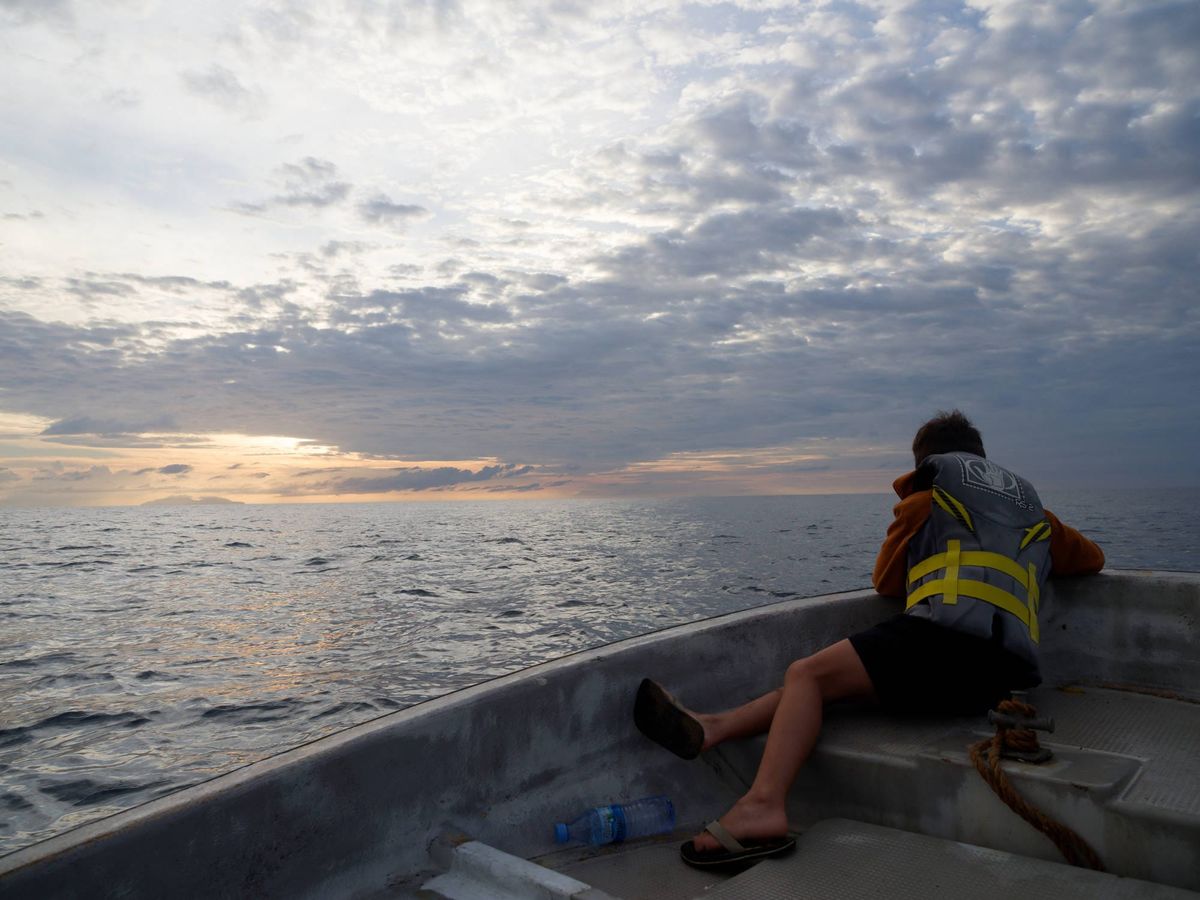
Suffering Missionaries
Our organization is building a new base and we were the first ones to move into one of the new houses. Our house is so nice that I think we can't be called missionaries anymore. In my mind, the word "missionary" conjures up a mental image of people suffering for the Gospel and I'm not sure we're suffering much. Not when it comes to housing, at least. It's so bad that Janice and I have been sitting around devising ways to make the children suffer more, such is our concern for their character.
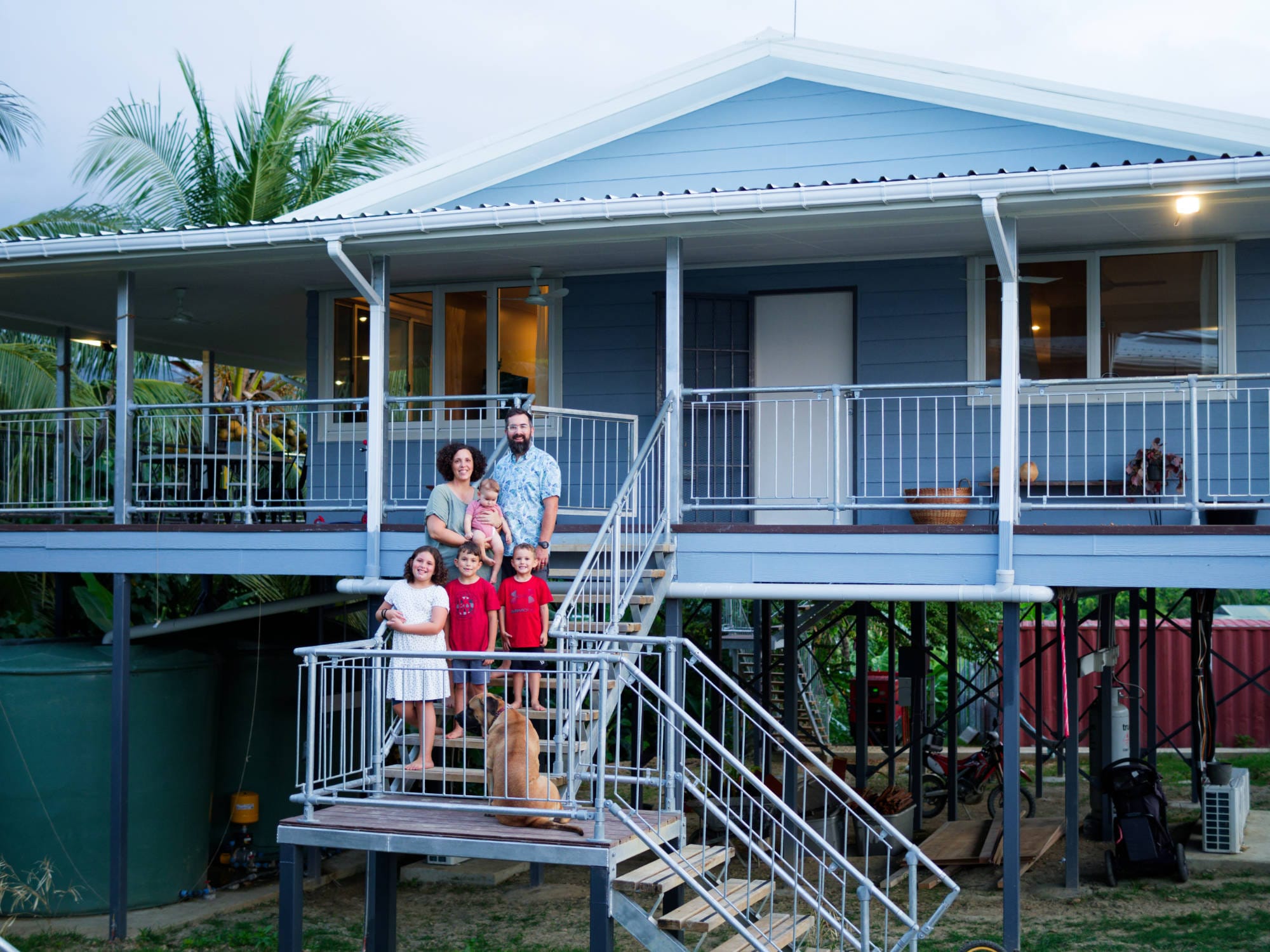
Now I realize it is a strange thing to be complaining about such things but now that we're living in one of the nicest houses in the Sepik River watershed (which is like 30,000 square miles or more), I can't help but feel a little self conscious about the disparity between my lifestyle and the local population. If we were in America, it'd be nothing special. But If you take a little slice of normal, everyday America and drop it - SPLAT! - into the middle of a Papua New Guinean village, the American lifestyle suddenly looks ridiculously excessive; gluttonous even. When you take the ocean between the lifestyles away and the only thing left separating them is a chainlink fence, suddenly the contrast is pretty stark. It makes me uncomfortable and I'm not sure what to do about it. Admittedly, as many Americans do, I may be falling into the trap of thinking that stuff equals happiness. And so people with fewer things than me are suffering. Of course that's not true.
There's a road here that runs parallel to a beach and many times I've been zooming along that road, all stressed about the time, about the potholes, and about some sequence of events that have fallen into each other like a row of Dominoes, when I'll look over and see a gray haired man leaning against a palm tree. The beach breeze is blowing nicely and no doubt I'd hear the rustle of palm fronds if I didn't have a diesel engine screaming under my seat and the song "I'm A Man of Constant Sorrows" wailing from the stereo. He'll be sipping from a coconut and little children will be running around, likely distant offspring of his. And I'll realize that I'm the poor guy. That old man doesn't have much, but he has enough and he's not the guy with high blood pressure. Really, aren't we all just trying to figure out how to spend more time with the people we love? There are many Americans who would pay a lot to trade places with that guy for a few days. Living here, you begin to realize all the stuff you think is necessary really isn't. But I haven't taken a vow of poverty yet. In fact, I still have the gall to feel like a martyr at times. So for now I think gratitude is my best option; to be aware I have a lot and to be grateful for it. And generous with it.
Take my wife Janice, for example. She even shares her own name sometimes.
Baby Names
Since our organization flies medevacs out of the jungle we see a lot of things like arrows sticking out of people, snake bites, and births gone wrong, just to name a few woes. That's why we really love new babies. It's nice to have a victory. And, in America at least, the first thing you ask when you meet a new baby is, "What's the baby's name?" But here it's not at all uncommon for the parents not to name the baby for months. And if you ask what the name is, they'll say something like, "He doesn't have a name yet. What name do you want to give it?" And you'll stammer around, trying to figure out how to handle this cultural situation. It's a common thing for new babies to get named after the pilot who flew them to the hospital. There are plenty of Marks, Matts, Lukes, Nicks, and maybe even a few Antons running around the East Sepik Province. The longer a pilot serves, the more prodigy they accumulate. After awhile you get a little tired of pilots getting all the glory.
So the other day when Janice was visiting patients at the hospital and she happened across a family with a new baby girl, she was ready.
"What's her name?" Janice asked.
"She doesn't have a name yet," they replied. "Do you want to name her?"
"I think you should name her Janice!"
And so she was.
Janice met the grandmother at a store in town two weeks later and confirmed that baby Janice is still doing well and is, in fact, still being called Janice. It seems like the name stuck.
Actually, getting things stuck reminds me of our fishing trip the other week. We took some guys from the hangar fishing and we hooked a French sailboat, which you may assume is a species of fish. It isn't. It was actually a French sailboat.
Airplanes & Sailboats
So we have three local guys who work in the hangar, two of which are trying to become what the Papua New Guinea system calls LAMEs, or Licensed Aviation Maintenance Engineers. Yes, it is a lame acronym. In America we would use the term "apprentices." Since I am a LAME, they work under me. I have to supervise and sign off all their work and, in theory, teach them stuff along the way. They are great guys and eager to improve their lives. This makes me wish, quite frequently, that they had a better supervisor. But here we are.
We were working on our trouble child; P2-SAC (nicknamed "Charlie"), an appropriately registered Cessna 206 floatplane. Every time it comes in for a 100 hour inspection (every 100 hours of flight time requires specific inspections) we know what our future holds: corrosion removal and painting, a time consuming, messy process that produces little squares of new paint that somehow never match the old, making the airplane look like it's covered by a patchwork quilt. It's immensely unsatisfying. And every time the inspection takes too long so we say things like, "Well, we'll just do this the quick way and next time we'll make it look good." We all know that "looking good" is never going to happen, but we feel better by saying it.
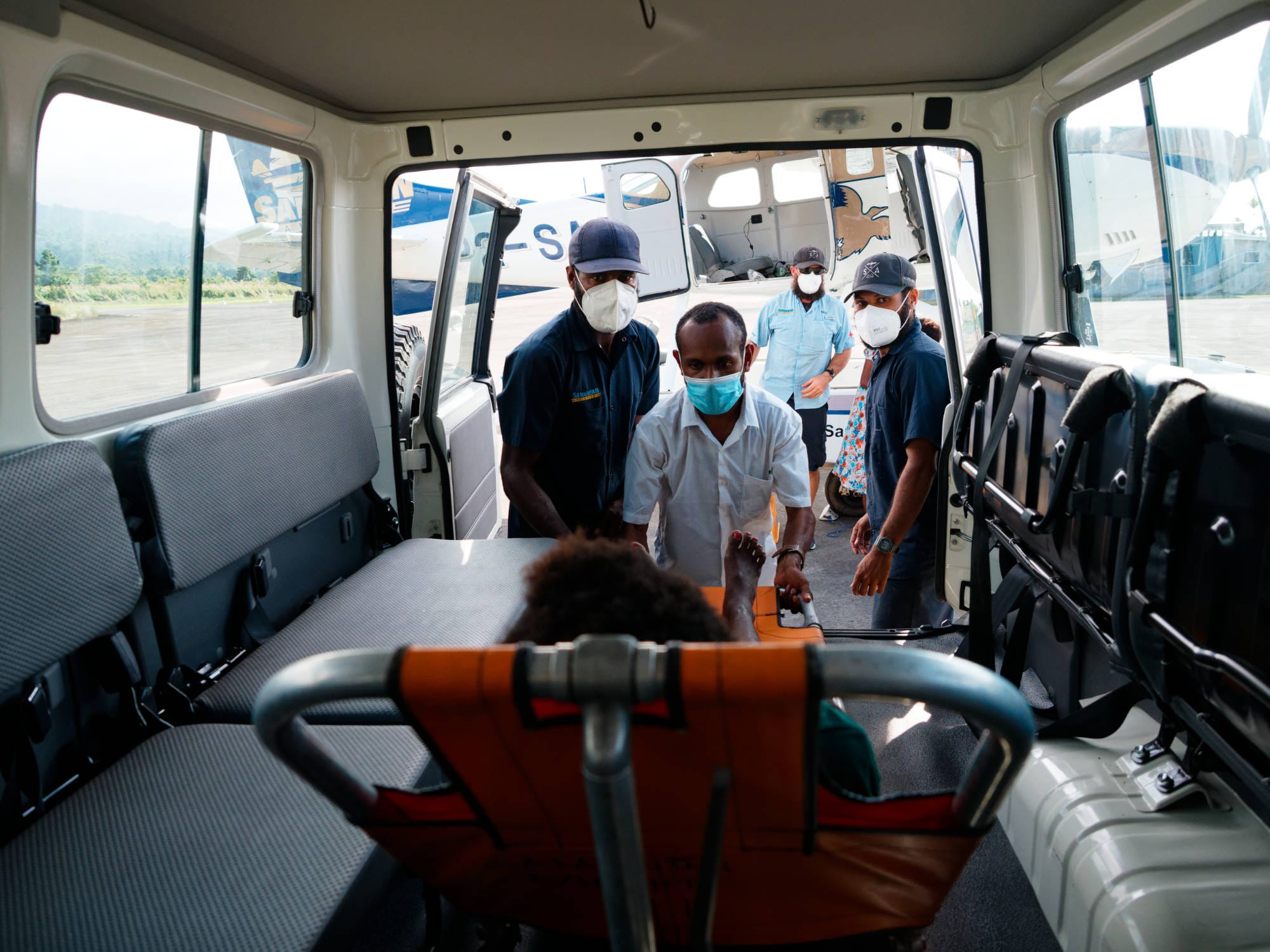
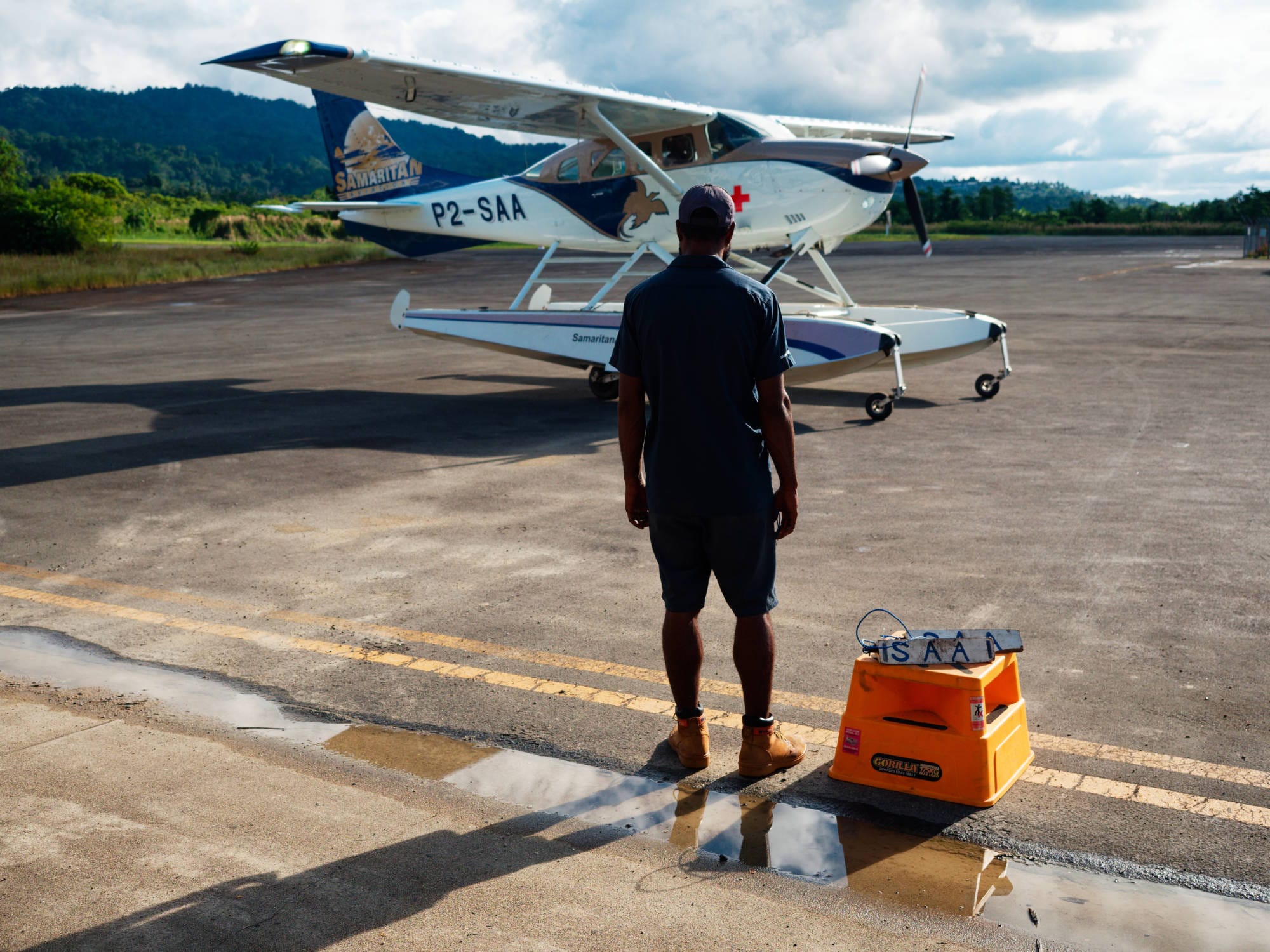
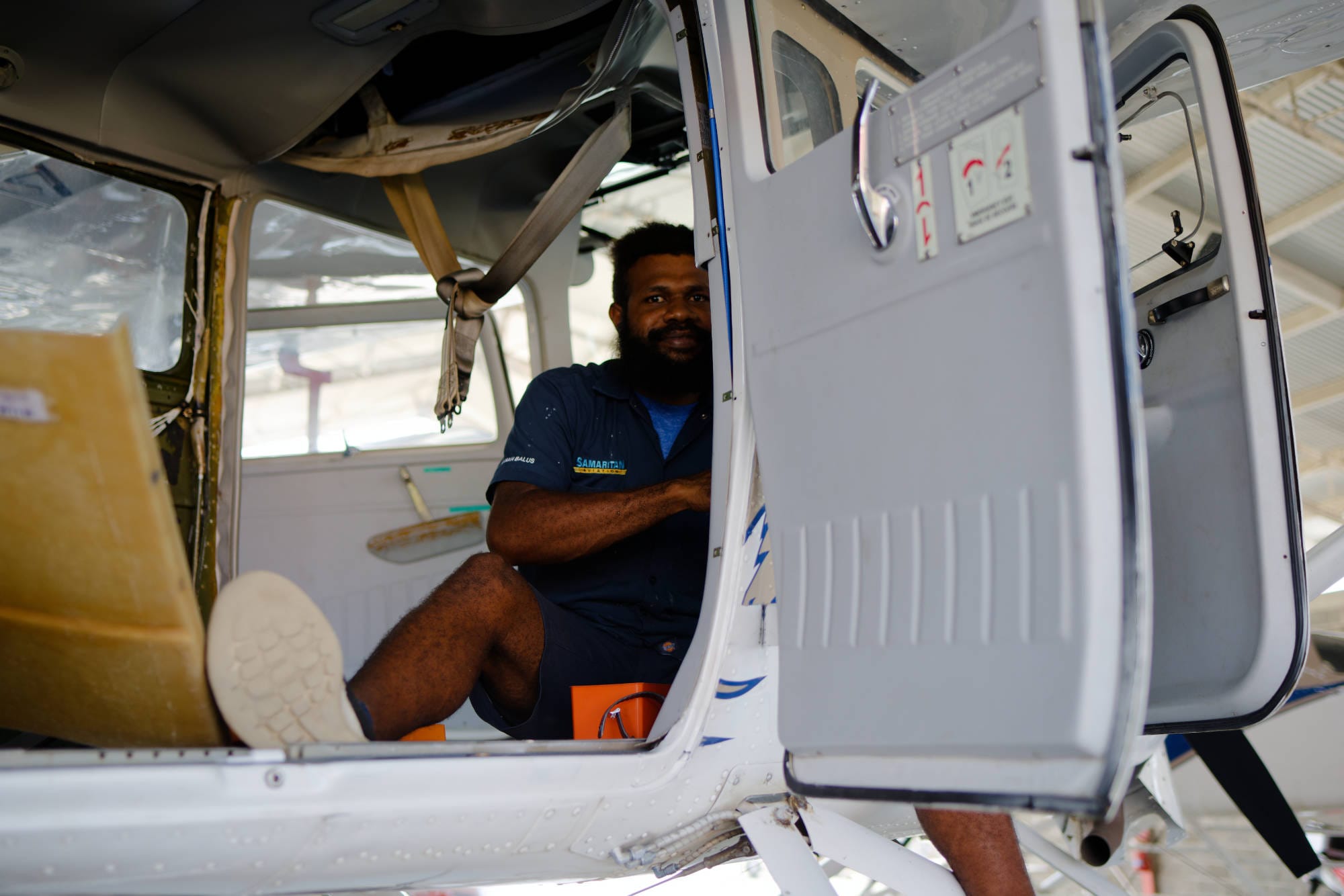
When our family arrived in Papua New Guinea two months ago, Charlie was in hangar waiting for me, like quicksand in the jungle. The maintenance department was short staffed and the inspection was going so slowly that a bird had built a nest in the elevator, laid eggs, hatched them, and had three fledglings ready to leave the nest by the time I had signed the logbook entry.
Still, when the 100 hour inspection was finally finished we wanted to treat the apprentices to a fishing trip as a reward for their hard work. So we got up at 5 am, picked up Xavier, Karu, and Ramsey, hopped on Samaritan's fiberglass boat and motored out to an area of the ocean where a reef rises up close to the surface. Larger fish like to school up there as they eat smaller fish. The fishing there is good, or so I'm told. I've never seen it. Well I did see it once, when it was raining sideways and everyone on the boat was soaked to their skin and we were laughing through our chattering teeth because we were hooking large mackerel like we were in the fresh fish aisle of a supermarket. It hasn't happened to me since, so my theory is that fishing in nice weather is pointless. Unless you're just out there to enjoy the weather, of course.
Which is what we did on this particular fishing trip. We trolled up and down, back and forth. I left the motoring to more skilled operators and settled down on a bench seat to take a nap, confident in my theory that the weather was too beautiful to catch anything except sleep, which I wanted more than fish anyway. Eventually we made our way back into the bay right outside town. A large sailboat had anchored up there a few days ago and we were curious who they were. As we crossed the bay we managed to hook some sort of small, slippery fish, probably because the water was too shallow for it to avoid the hook. The locals call it a "Bot Bot" because that's the sound it makes when you catch it. It was unimpressive but at this point in the trip it was met with a lot of enthusiasm because our expectations had dropped quite a bit. We put the lines out again and continued over to the sail boat, taking a wide arc around it.
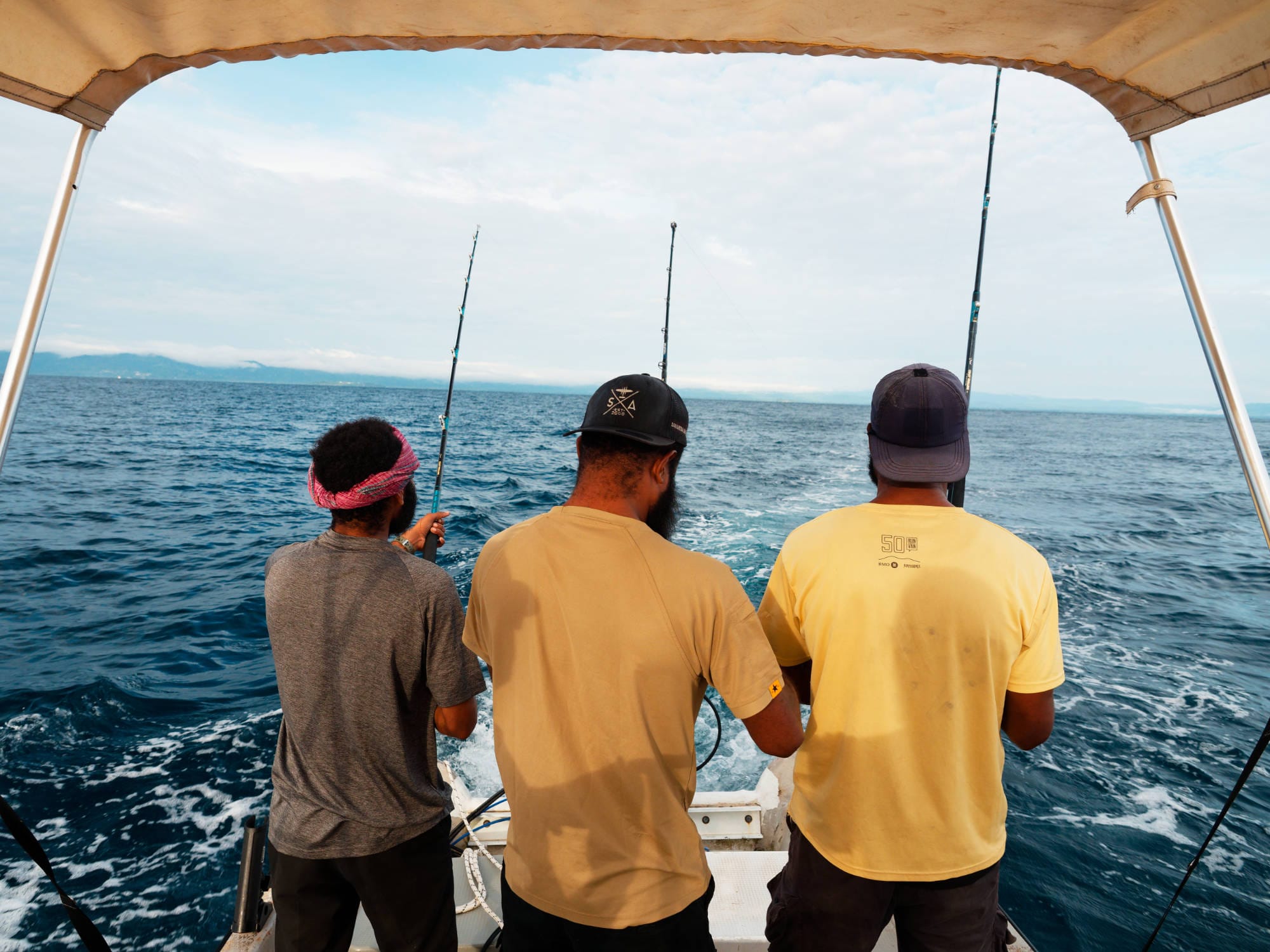
That's when Xavier's reel suddenly began screeching and everyone else did too. "Fish on!" After a lot of wrestling, grunting, and unbelievable estimations of the size of the fish we had just hooked, it began to dawn on everyone that we hadn't caught a fish, but rather a boat, which can be more exciting than a fish in my opinion. There was one boat in the whole harbor and we had snagged it. So we sauntered back to the sailboat like a bunch of children who had just misbehaved but were trying not to be obvious about it. While we were bobbing around just off the stern of the sailboat trying to figure out exactly how to get our lure back (lures valuable here because they're impossible to get) a woman appeared on deck. We found out she was French and the sailboat was full of European scientists who had come to study coral.
"Neat!" Luke shouted, "Hey, I think we hooked your anchor line."
She took a few moments to absorb this information, trying to figure out if we were pirates or just idiots. Then she decided she didn't feel like dealing with either and opened a hatch and disappeared. We were left bobbing there.
"Well, she's French. What did we expect? Let's go get our lure."
Maybe next fishing trip we'll have the good fortune of bad weather. But for now I have to get back to the hangar. Another plane, P2-SAB, needs a 100 hour inspection. Sigh.